How to Create an Invoice: A Practical Guide
By Innvoic
Nobody teaches you how to invoice. You finish the work, you feel great, and then you stare at a blank document wondering what a proper invoice even looks like. Do you need a logo? A special format? Some magic legal phrasing? credit note generator
You need almost none of that. An invoice is a request, not paperwork. It says four things: here’s what I did, here’s what you owe, here’s how to pay me, and here’s when. Everything on a good invoice exists to make those four things unmistakable. This guide covers the whole thing the way an experienced freelancer would explain it over coffee.
How to create an invoice in 7 steps
- Add your details. Your name or business name, your address, and a way to reach you, at the top of the invoice.
- Add your client’s details. Who you’re billing — for a company, use its legal business name and address.
- Number the invoice. A unique number, ideally sequential (INV-2026-001, then INV-2026-002).
- Date it. The issue date plus a clear due date, or terms like Net 30 if that’s your arrangement.
- Write specific line items. What you did, how much of it, and the rate — specific lines get fewer questions and faster payment.
- Total it up. Subtotal, any tax that applies, and the final amount due.
- Say how to get paid, then send it. Put your payment details on the invoice, send it as a PDF, and follow up politely if the due date passes.
What an invoice actually is (and what it isn’t)
People mix up four documents, and the confusion costs them money. Here’s the plain version:
A quote is a fixed price you offer *before* the work starts. “I’ll redesign your homepage for $2,000.” If the client says yes, you’re locked into that number. If you need to send one, that’s a separate document, and you can make it with a free quote generator.
An estimate is your best guess when the scope might shift. “Probably 10 to 14 hours at $80 an hour.” It sets expectations without locking you in.
An invoice comes *after* the work. It references what was agreed and asks for payment. This is the document you’re writing now.
A receipt comes *after* the payment. It’s your confirmation to the client that the money arrived. You send it, not them.
The order is: quote or estimate, then work, then invoice, then receipt. Mixing them up (like sending something labeled “invoice” before the work is done) confuses clients and slows payment.
The fields every invoice needs
Group them by the question each one answers, and you’ll never forget one.
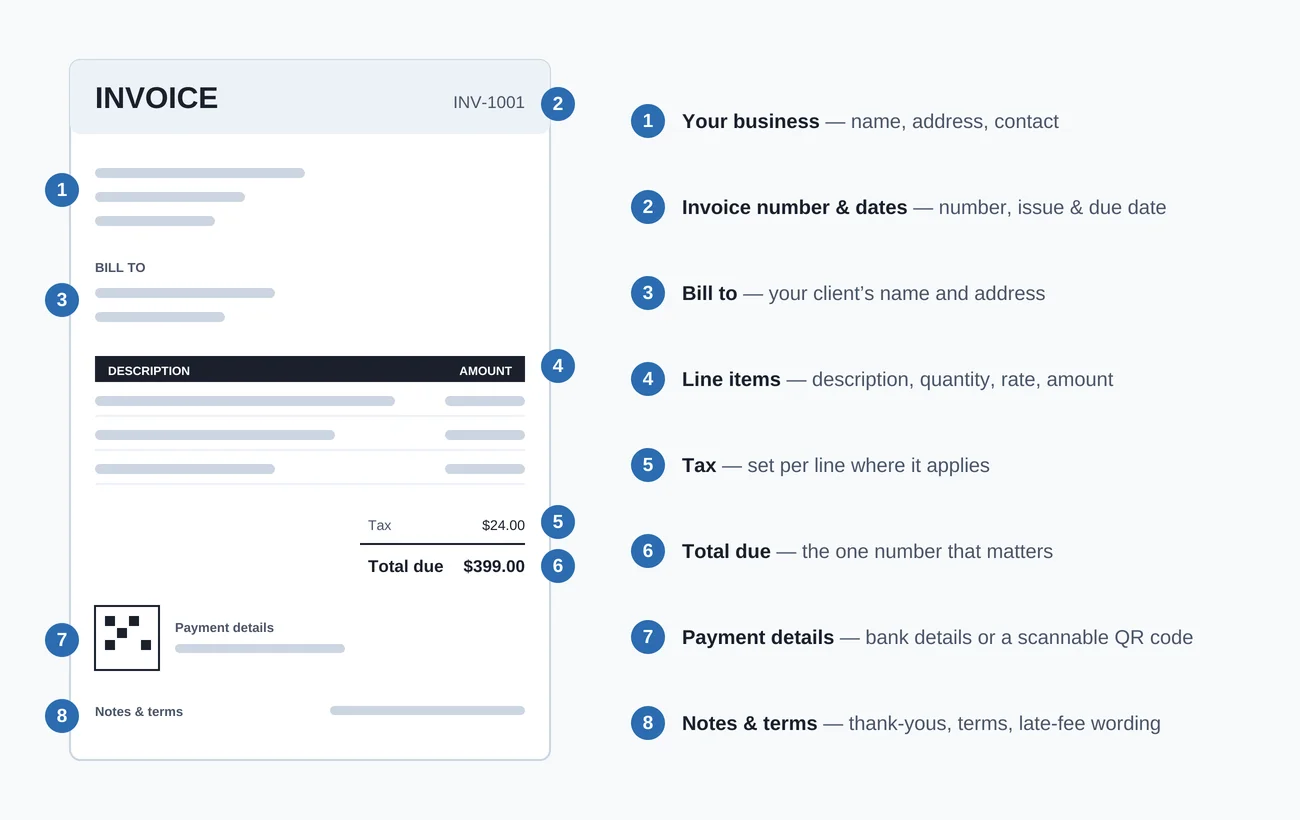
Who’s involved. Your name or business name, your address, and a way to reach you. Then the client’s name or business name and their address. If you’re billing a company, use the company’s legal name, not just your contact’s name. Invoices made out to the wrong entity bounce around accounting departments for weeks.
What was done. Your line items: a description, a quantity, a rate, and the amount per line. More on writing these well in a minute.
Which invoice this is. A unique invoice number. Every invoice gets its own, never reused.
When. Two dates: the issue date (today, when you send it) and the due date (when payment is expected). Write the due date as an actual calendar date. “Due November 15, 2026” beats “Net 30” because nobody does the math.
How much. Subtotal, any discount, tax if it applies to your situation, the total, any amount already paid, and the balance due. If nothing’s been paid yet, the balance due equals the total. Stating it explicitly removes all doubt.
How to pay. Your actual payment details. Bank transfer info, PayPal address, check mailing address, whatever you accept. This is the field people forget most often, and it’s the one that directly controls how fast you get paid. Don’t make a client reply asking “how do I pay you?” That’s a week lost.
One note before we go further: this guide covers the practical side of invoicing, but it isn’t tax or legal advice. If you’re unsure what your local rules require on an invoice, check with a tax professional where you live.
Invoice numbering that won’t embarrass you
Pick a system on invoice number one and stick with it forever. The classic format works fine: INV-2026-001, then INV-2026-002, and so on. The year keeps things tidy, and the sequence keeps them unique.
Three rules. Keep them sequential with no gaps, because gaps make clients and accountants ask questions you’d rather not answer. Never reuse a number, even if an invoice gets canceled (mark it void instead). And don’t get clever with separate sequences per client. One sequence, all clients, forever. Future you, doing taxes at midnight, will be grateful.
Write line items clients don’t argue with
Vague line items get questioned. Specific ones get paid. Compare:
“Web services: $900” invites a reply asking what that was.
“Homepage redesign, 12 hours at $75 an hour = $900” answers every question before it’s asked.
The formula is simple: what you did, how much of it, at what rate, and the math shown. A few more examples: “Logo concepts (3 rounds), flat fee, $600.” “Blog post, 1,200 words, $0.25 per word = $300.” “Consulting call, 3 hours at $150 = $450.”
If you did a dozen tiny tasks, group them into one sensible line rather than twelve fiddly ones. And if something was discounted or free, show it: “Rush delivery, waived, $0.” Clients remember generosity they can see.
Payment terms in plain English
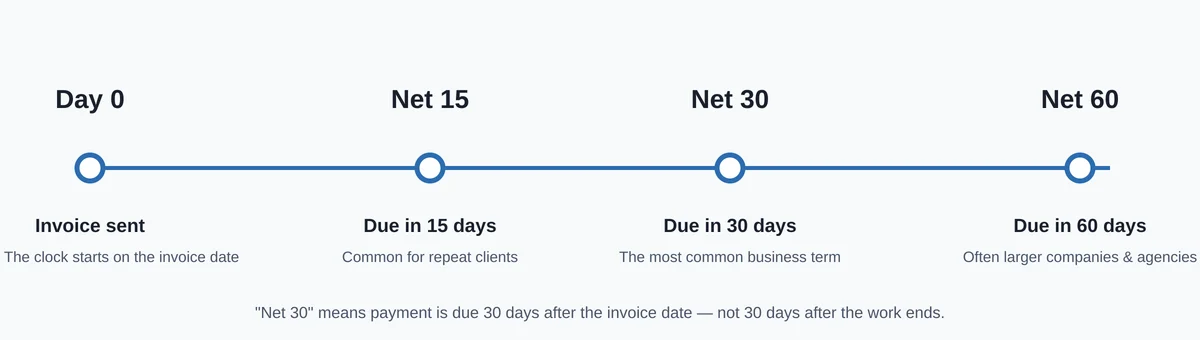
“Net 15” means the client has 15 days from the invoice date to pay. “Net 30” means 30 days. “Net 60” means 60. That’s the whole mystery. “Due on receipt” means pay now, though in practice people still take about a week.
Net 30 is the business standard, and there’s nothing wrong with it. But if cash flow matters to you (and it does for most freelancers), net 15 is perfectly reasonable to ask for. What matters more than the number is stating it twice: once as the term and once as the calendar date. “Payment terms: Net 15. Due: November 15, 2026.” Nobody has to calculate anything, and nobody can claim they didn’t know.
If you want teeth behind the terms, add a late fee clause to your invoice terms before there’s ever a problem, something like a 1.5% monthly charge on overdue balances. On a $900 invoice that’s $13.50 for the first month late. A late fee calculator can run the exact numbers for you, and having the clause printed on the invoice does half the work of enforcing it.
Send it right, then follow up without the awkwardness
Send the invoice as a PDF attached to an email. PDFs look the same on every device and can’t be quietly edited. In the email subject, put the essentials: “Invoice INV-2026-014 from [Your Name], due Nov 15.” The client should know what it is and when it’s due without opening anything.
Here’s the step most people skip: confirm you’re sending it to the right person. At a company, your day-to-day contact often isn’t the person who pays bills. One sentence saves weeks: “Who should I send the invoice to for processing?” Send it to accounting directly and your “net 15” might actually mean 15 days.
Then follow up. Most late payments aren’t malice, they’re inbox chaos. Wait until two or three days after the due date, then send something short and warm. Here’s one you can copy:
> Hi [Name], just floating this to the top of your inbox. Invoice INV-2026-014 for $900 was due on November 15. Let me know if you need anything from me to get it processed. Thanks!
That’s it. Polite, specific, and it gives them an easy out (“oh I just need the W-9” or whatever). If another week passes with silence, that’s when you get firmer. There are full follow-up templates for the gentle, firm, and final stages when you need them.
The 5 mistakes that delay payment
1. Vague descriptions. “Services rendered” tells the client nothing. If they can’t understand the charge in five seconds, it goes into the “deal with later” pile.
2. No due date. An invoice without a clear due date has no urgency. “Net 30” buried in small print barely counts. Put the calendar date where eyes land.
3. Missing payment details. You explained what they owe but not how to pay you. Every back-and-forth email about payment method is another week of waiting.
4. Math errors. Line items that don’t add up to the total destroy trust instantly, even when the mistake favors the client. Let a tool do the arithmetic instead of your tired brain at 11pm.
5. Sending it to the wrong person. Your contact says “looks good!” and forwards it to accounting three weeks later. Ask who processes invoices and send it there yourself.
Do it now
You’ve just read the whole playbook. The actual invoice takes about ten minutes: your details, their details, a number, two dates, specific line items, the total, your payment info, and a due date. That’s the job.
If you’d rather not build the layout yourself, the free invoice generator at https://innvoic.com/ handles the formatting, the numbering, the totals, and the PDF, right in your browser with no signup. And if you want a head start on paper, there are ready-made invoice templates you can download and reuse.
Send the invoice today. Future you, with money in the account, says thanks.
Do I need to register a business before I can send an invoice?
No. You can invoice as an individual using your own name. Plenty of freelancers operate that way for years. A registered business name can look more professional and may matter for taxes depending on where you live, but it’s not a prerequisite for billing a client.
What should my very first invoice number be?
Something like INV-2026-001. Start at 001, go up by one each time, and never reuse a number. The format matters less than the consistency, so pick one system and keep it for every client.
How long should I give clients to pay?
Net 15 or net 30 covers most freelance work. Net 30 is the standard expectation in business, while net 15 keeps your cash flow healthier. Either way, print the actual due date on the invoice rather than relying on the client to count days.
Should I charge a late fee on overdue invoices?
You can, but put the clause on the invoice (or in your contract) before payment is ever late, not after. A common setup is a small monthly percentage on the overdue balance. This isn’t legal advice, so check what your area allows before you enforce one.
Can I invoice a client in a different currency?
Yes, as long as you both agree on it upfront. State the currency clearly on the invoice so there’s no confusion at payment time. If exchange rates might swing between invoicing and payment, agree in advance whose rate you’ll use.
What’s the difference between an invoice and a receipt?
An invoice asks for payment; a receipt confirms payment happened. You send the invoice before you’re paid and the receipt after. Sending a receipt-style document when you actually want money is a surprisingly common mix-up, so label yours clearly.
—
Related
- US Invoice Generator
- Invoice Templates
- Quote Generator
- Payment Reminder Templates
- Late Fee Calculator
- Freelance Invoice Generator
- Receipt Generator
Related: free invoice generator, invoice templates, late fee calculator, payment reminder templates.
See also: all invoice guides.
Choose the right invoice payment terms for your business.
See how to number your invoices for formats and mistakes to avoid.
See invoice email templates for copy-paste new, reminder, overdue, and thank-you emails.